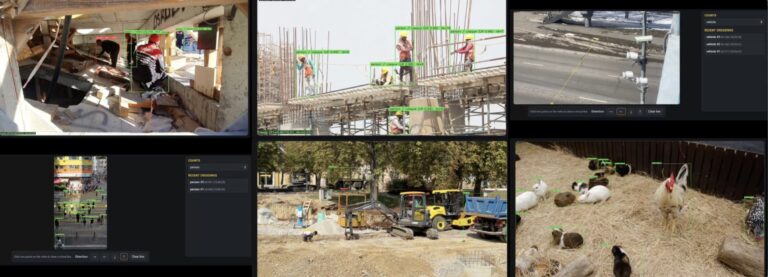
For several years, artificial intelligence has followed a near-universal path: collect data in the field, send it to a centralized server or cloud, run the models there, then return a decision. This model works well for many use cases. But it reveals its limitations as soon as you get close to real operational terrain: isolated construction sites, military installations, railway corridors, areas without network coverage.
That is precisely where embedded edge AI changes the rules.
The cloud is not always where you need it
The first reason is straightforward: connectivity. A sensor deployed on a construction site, in a rural area, a remote critical infrastructure, an abandoned sensor in a military surveillance zone — these often have no access to a stable internet connection, or to any connection at all. Waiting to “push the data upstream” before triggering an alert means accepting a latency that is incompatible with security requirements.
In the environments where VISEIO operates — isolated, temporary, or sensitive sites — this reality is the norm, not the exception. The decision must be made at the edge, within milliseconds, without depending on an uplink.
“The safest data is the data that never leaves the sensor. The fastest decision is the one that doesn’t wait for the server.”
Latency: the enemy of real-time security
Even with excellent connectivity, the cloud round-trip introduces an incompressible latency: a few hundred milliseconds at best, several seconds in the reality of degraded networks. For detecting an intrusion, a suspicious movement, or an acoustic anomaly on a critical infrastructure, that is too long.
Local analysis on an embedded model reduces this latency to a few tens of milliseconds. The system shifts from one that observes and reports to one that detects and reacts. The distinction is significant in operational security terms.
Data sovereignty: a non-negotiable requirement
On sensitive sites — energy infrastructure, defense installations, critical transport networks — sending video or acoustic streams to a third-party cloud in a forekign country raises sovereignty and compliance questions that few operators can afford to ignore. Who stores this data? Under which jurisdiction? Who can access it?
The embedded approach provides an architectural answer to these questions: only the detected event is transmitted, never the raw stream. The model runs locally; the sensory data never leaves the sensor. This is a technical guarantee, not a contractual promise.
Energy efficiency as a design constraint
Embedding intelligence does not mean embedding a server. Advances in dedicated inference architectures — NPUs, specialized microcontrollers, low-power accelerators — now make it possible to run multimodal detection models within a few milliwatts.
For sensors deployed on battery or solar power — such as those developed by VISEIO — this constraint is foundational. The embedded model must be compact enough to fit within the device’s memory and thermal envelope, while remaining expressive enough to cover the targeted use cases. This is one of the central challenges of the embedded foundation model VISEIO is developing.
Reconfigurability: the best of both worlds
Edge AI does not exclude the cloud — it redefines its role. In the VISEIO architecture, the central AI agent is not on the critical path for detection. It intervenes upstream (model updates, reconfiguration of detection parameters, context adaptation) and downstream (event aggregation, trend analysis, sensor network supervision).
This hybrid model — local inference, central supervision — is the target architecture for large-scale deployments across heterogeneous environments. It combines the resilience of the edge with the orchestration power of the cloud, without being subject to its operational constraints.
Key takeaways
Embedded edge AI is not a marginal technical optimization. It is a structurally defining architectural choice, simultaneously addressing constraints of connectivity, latency, data sovereignty, and energy efficiency. For the environments where VISEIO operates — isolated, sensitive, sometimes hostile — it is the only approach that genuinely delivers on its promises in the field.
In upcoming editions, we will explore how this architecture translates concretely into the design of VISEIO’s embedded foundation model, and why multimodality (vision + acoustics) sits at its core.
© 2026 VISEIO · Sovereign infrastructure for distributed intelligence